Body System
Besides the actuators, the robot’s body carries an on-board computer and a battery that powers everything.
Single-board computer
The baseline on-board computer for the robot is the Radxa ROCK 3C single-board computer.
Setting up the board
An SD card for the OS is provided in the course.
- Before you start: read the ROCK 3C getting started guide in the Radxa documentation.
- Download the OS image from the ROCK 3C OS images page. We recommend Rock3C-Debian12-Bookworm-kde-b1.img. The downloaded file is named
rock-3c_bookworm_kde_b1.output_512.img.xz. - Write the image to the SD card and boot the board. The Radxa wiki getting started page has easy-to-follow step-by-step instructions.
Alternative: NVIDIA Jetson Orin Nano
Teams can also use an NVIDIA Jetson Orin Nano as the on-board computer instead of the ROCK 3C. See NVIDIA’s official pages:
Battery and power circuit
The robot uses two separate batteries: a 24 V battery for the motor drivers, and a 12 V battery for the computer and the control circuit.
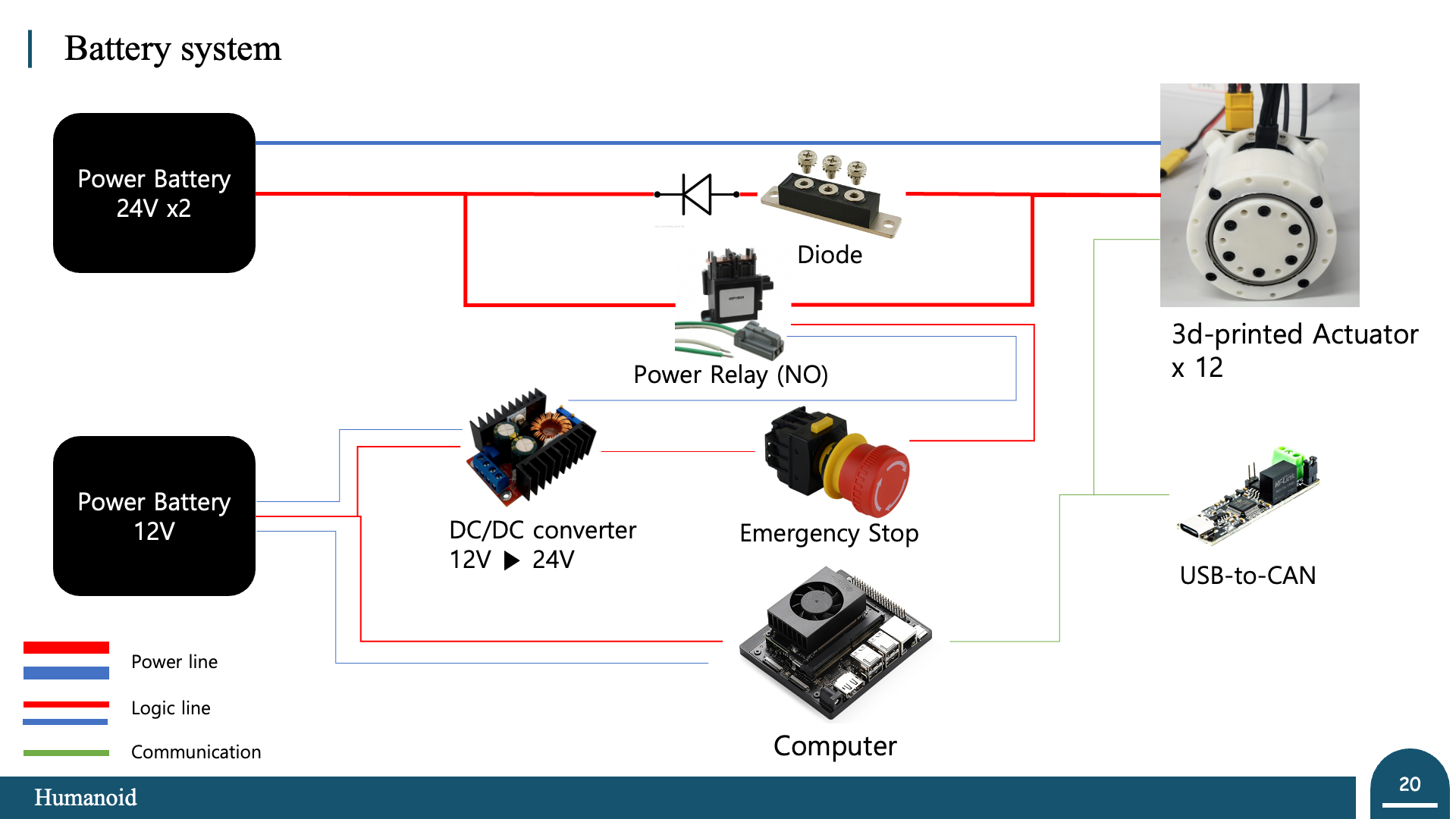
Battery system. Thick lines: power. Thin lines: logic. Green lines: communication.
24 V: motor power
The 24 V battery (two batteries in parallel) powers the 12 motor drivers. On the way, the power line passes through a Schottky barrier diode and a power relay (normally open), which are connected in parallel.
12 V: control power
The 12 V battery is split two ways:
- Relay control: through a 12 V → 24 V DC/DC converter (booster) to the power relay’s signal line. The emergency stop button is on this line.
- Computer: to the single-board computer.
If your single-board computer runs on 5 V, you need a separate voltage regulator for it.
Layout in the body
The body frame has several floors:
| Position | Components |
|---|---|
| Top (third) floor | 12 V → 24 V booster, computer |
| Second floor | 12 V battery, diode, power relay, emergency stop button |
| First floor | 24 V batteries (two, in parallel) |
| Bottom | IMU |
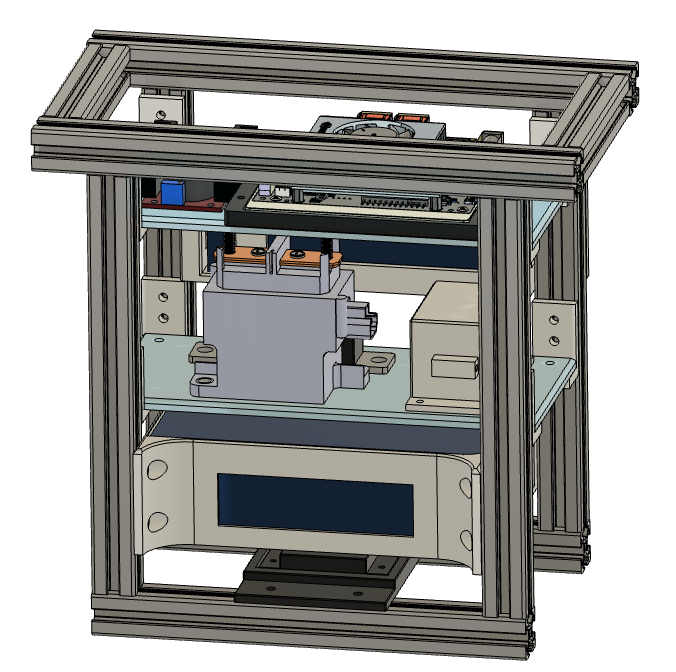
CAD model of the body assembly.
Reference: MEVITA
For reference, see the hardware documentation of MEVITA, an open-source bipedal robot: